Why We Are Building Ezrah: Digital Infrastructure for the Intelligence Age


In Greek mythology, Pandora’s Box was a vessel of divine mystery. According to legend, Pandora, the first woman, was instructed never to open it. But as curiosity overwhelmed caution, chaos spilled into the world: disease, suffering, and evils unleashed beyond control. Yet, one thing remained at the bottom of the box - hope.
Today, artificial intelligence (AI) is our own Pandora’s Box, an irreversible force already transforming economies, labor markets, and even the global risk landscape. The World Economic Forum’s Global Risks Report 2023 lists large-scale cyberattacks and data fraud, often exacerbated by AI, as among the top concerns for businesses worldwide. While fears of disruption are real, AI also embodies possibility. Unlike Pandora, however, we’re not hapless observers. We can shape how AI augments, automates, and redefines our world. At Ezrah, our mission is to build digital infrastructure that empowers people to flourish in this new age of intelligence, while safeguarding against its inherent risks.
The Death of Traditional Work and the Rise of the Creator Economy
AI Displacing Jobs—A Crisis or an Evolution?
In the industrial era, the 9-to-5 job and centralized corporate structures defined our understanding of work. As AI matures, these frameworks are deteriorating at an unprecedented rate. According to McKinsey Global Institute (2017), up to 375 million workers might need to switch occupational categories by 2030 due to automation. Tasks once reserved for lawyers, financial analysts, medical diagnosticians, and software engineers are now within AI’s capability.
Robotics and AI-driven systems similarly threaten blue-collar roles. PwC (2018) estimates that up to 30% of jobs could be automated in some economies, leading to corporate downsizing and fears of mass unemployment. Yet historically, new technologies—from steam engines to the internet—have often created more jobs than they replaced. The MIT Task Force on the Work of the Future (2020) underscores this “dynamic evolution”: while AI may displace certain tasks, it can also spawn new opportunities that require human creativity and empathy.
The Individual as a Self-Sustaining Institution
As large organizations automate or downsize, individuals will increasingly establish autonomous digital enterprises, powered by AI:
- AI-Powered Solopreneurship
Tools once accessible only to corporations, like enterprise-grade analytics, marketing automation, and supply chain management—are being integrated into affordable AI platforms (Deloitte Insights, Future of Work). A single creator can effectively run a full-stack media company or consulting firm, delegating mundane tasks to AI. - Monetizing AI-Driven Services
Generative AI is already producing art, copywriting, music composition, and software prototypes. As Harvard Business Review notes, solopreneurs can now harness these capabilities to deliver specialized products and services with minimal overhead, ushering in a novel creator economy. - Decentralized Learning & Expertise
Instead of relying on formal degrees, AI-driven education platforms empower people to become self-taught experts (OECD, Future of Work). Microlearning and proof-of-work portfolios supplant traditional qualifications, democratizing skill acquisition.
Just as the internet evolved from rudimentary browsers to e-commerce (Amazon) to social networking (Facebook) and finally to social commerce—where individuals monetize their digital presence—AI is on a similar trajectory. We remain in an early phase, but soon AI’s ability to automate, create, and distribute will enable anyone to build a scalable enterprise without a large institutional apparatus.
Growing Global Concern Over AI Risks
Why Businesses Are Worried
As much as AI offers productivity gains, it also introduces new forms of vulnerability. The World Economic Forum (2023) pinpoints AI-driven cyberattacks, deepfakes, and data manipulation as high-impact risks for organizations across industries. Brookings (TechTank blog) adds that fraudulent AI-generated content can damage brand reputations, compromise security, and erode stakeholder trust.
Key Risk Areas:
- Data Security and Privacy: Large language models and other AI systems often require vast amounts of data, amplifying concerns about data breaches and misuse.
- Ethical and Regulatory Gaps: Rapid AI deployment can outpace policy frameworks, creating uncertainty for businesses seeking compliance with emerging laws (e.g., the EU’s AI Act).
- Existential Economic Threats: For sectors overly reliant on routine or predictable tasks—such as manufacturing, legal research, or financial auditing—AI may upend entire business models, forcing costly reorganizations (McKinsey Global Institute, 2017).
By 2025, Gartner predicts AI-related risks will become a top focus for enterprise risk management teams. Companies thus face a dual challenge: leverage AI’s capabilities while mitigating associated threats. This underscores why solutions that provide secure digital identities and reliable data verification are increasingly mission-critical.
Decentralization as the Next Frontier
Breaking Down Institutional Barriers
For centuries, centralized institutions—universities, banks, and media conglomerates—controlled knowledge, capital, and public narrative. Today, AI weakens these structures by reducing information asymmetry (OECD, Future of Work). Individuals and startups can access sophisticated modeling tools, global markets, and investment strategies once monopolized by large corporations.
- Microlearning and Skills: Personalized AI tutoring reduces the relevance of formal degrees, allowing direct proof-of-work to validate expertise.
- Decentralized Finance (DeFi): AI-driven predictive analytics empower individuals to invest, lend, or borrow without traditional intermediaries (European Commission, AI Policy & Ethics).
- Peer-to-Peer Markets: Decentralized networks bypass conventional gatekeepers, fostering direct interactions between service providers and consumers (Brookings, TechTank).
Each technological revolution, from the printing press to the internet, democratized communication and commerce. AI goes a step further, democratizing expertise and market participation. This shift grants individuals unprecedented autonomy, but it also raises critical questions about verifiability and trust—especially as AI-generated content blurs lines between real and fake.
The Importance of Verifiable Identity and Data Ownership
Building Trust in an AI-Driven World
A chief concern in the AI era is trust. As AI tools become adept at producing hyper-realistic images, videos, and even voices, the threat of deepfakes and fraudulent content grows. The W3C’s Decentralized Identifiers (DIDs) standard aims to fortify identity verification without relying on single authorities. Similarly, the ID2020 Alliance works on universal digital identity frameworks (W3C, 2022; ID2020, n.d.).
- Decentralized Identity Standards
By enabling self-sovereign identity, individuals can manage and validate their own credentials without relinquishing ownership to centralized databases. - User-Controlled Data
In an era of data-hungry AI models, user-centric platforms can mitigate privacy breaches. By restricting how data is collected and monetized, individuals maintain control over their digital footprint. - Reputation Systems
Where AI can replicate almost any digital asset, building a verifiable reputation becomes paramount. Transparent, tamper-proof records allow businesses and individuals to trust that what they see or buy is authentic.
The Near-Term Reality: Median AGI
Many of these transformations hinge on a future where AI tools surpass roughly 50% of human professionals in various tasks, a state sometimes referred to as “Median AGI.” While timelines vary, the Stanford Institute for Human-Centered AI (2023 AI Index Report) indicates a growing consensus that AGI-level capabilities could emerge within the next decade, possibly earlier. This potential underpins both the excitement and anxiety surrounding AI. Entire job categories, from customer service to financial auditing, might be automated, forcing widespread retraining.
Nonetheless, as Brynjolfsson and McAfee (2014) argued, technology’s real promise lies in complementing human ingenuity. Instead of rendering human workers obsolete, AI can amplify their creativity and productivity, if society invests in the right infrastructure and skill development.
Ezrah: Gateway to Africa’s AI-Driven Future
Ezrah exists to address these twin imperatives of empowerment and risk mitigation. Our decentralized infrastructure ensures that individuals, businesses, and institutions can thrive securely in an AI-driven marketplace.
- Verifiable Digital Identity
We provide a foundation where users can securely prove who they are, what they’ve accomplished, and what they own, all without centralized gatekeepers. - Decentralized Data Ownership
In a world where biased data often skews AI models, Ezrah grants users the power to contribute and monetize their data ethically, thus helping to diversify global AI datasets. - Building Digital Reputations
Rather than trusting logos or legacy credentials, future markets will rely on transparent proof-of-work, project outcomes, and verified interactions. Ezrah’s approach ensures that achievements are immutably recorded and easily shared.
We focus particularly on Africa’s digital future. Historically, Western institutions dominated technological innovation, shaping data sets and capital flows. Our aim is to level the playing field—giving African entrepreneurs, creators, and professionals the infrastructure to compete and collaborate on a global stage. Whether launching a small business, freelancing in the global marketplace, or exploring DeFi, Ezrah provides the tools to establish trust in a world of AI-generated everything.
Trust in the AI Era: Ezrah’s Role in Secure Digital Identity
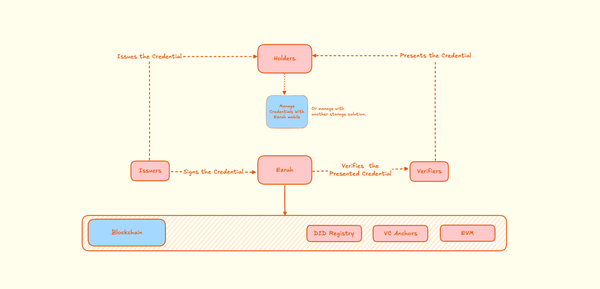
As AI tools become increasingly capable of generating hyper-realistic content, the threat of deepfakes, identity fraud, and misinformation grows exponentially. The need for verifiable, tamper-proof digital identity systems has never been greater. Ezrah is built on the W3C Decentralized Identifiers (DIDs) standard, ensuring that identity verification remains trustless, secure, and resistant to fraud.
Ezrah’s ecosystem is structured around three core pillars:
- Decentralized Identity Standards:
- Individuals own and control their credentials—Ezrah does not store or manage them.
- Secure cryptographic keys ensure credentials cannot be forged or tampered with.
- Built-in multi-key management and revocation features prevent compromise.
- User-Controlled Data:
- Zero-Knowledge Proofs (ZKPs) allow users to share only necessary information, protecting sensitive data.
- On-Chain vs. Off-Chain Data Balance:
- On-chain: DID registry (identity resolution).
- Off-chain: Verifiable credentials secured with X25519 encryption for privacy and efficiency.
- Regulatory Compliance: Fully adheres to global data protection laws, ensuring user sovereignty.
- Reputation & Verifiable Trust Systems:
- Digital reputation is anchored in tamper-proof, cryptographically verifiable credentials.
- No reliance on third-party verification—credentials are self-authenticating and instantly verifiable.
- AI & Identity Intersections:
- Prevention of Deepfake & AI-generated Fraud:
- Ezrah credentials ensure AI-generated content and decisions can be authenticated.
- Future-proofing AI agentic systems through credentialized authentication.
- AI Training Data:
- Users opt-in to share structured metadata from credential transactions, fueling trustworthy AI models.
- Prevention of Deepfake & AI-generated Fraud:
By decentralizing identity control, ensuring privacy-first data practices, and building tamper-proof reputation systems, Ezrah is positioning itself as the trust layer for the AI-driven future.
A Future of Empowerment, Not Destruction
While AI comes laden with risks—workforce disruption, regulatory uncertainty, and novel threats like deepfakes—it also heralds a new era of human empowerment. Freed from outdated systems, people can reinvent career paths, forge creative ventures, and develop solutions that address societal challenges in real time. But to thrive amidst AI’s upheavals, individuals need secure frameworks for identity, reputation, and data. That is where Ezrah comes in.
So while Pandora's Box has already been opened and chaos and opportunity are already at play, the real question is - Will you harness this power or be swept aside?
Our answer at Ezrah is clear: by enabling verifiable identities, decentralized ownership, and equitable access to AI-driven economies, we can ensure that hope, not fear, defines the future.
Selected References
- Altman, S. (2025). Three Observations. Retrieved from https://samaltman.com/three-observations
- Brookings Institution. (n.d.). TechTank Blog. Retrieved from https://www.brookings.edu/blog/techtank/
- Brynjolfsson, E., & McAfee, A. (2014). The Second Machine Age: Work, Progress, and Prosperity in a Time of Brilliant Technologies.
- Deloitte Insights. (n.d.). Future of Work Collection. Retrieved from https://www2.deloitte.com/insights/us/en/focus/future-of-work.html
- European Commission. (n.d.). AI Policy & Ethics. Retrieved from https://digital-strategy.ec.europa.eu/en/policies/european-approach-artificial-intelligence
- ID2020 Alliance. (n.d.). ID2020. Retrieved from https://id2020.org/
- McKinsey Global Institute. (2017). Jobs lost, jobs gained: Workforce transitions in a time of automation.
- MIT Task Force on the Work of the Future. (2020). Work of the future: Building better jobs in an age of intelligent machines.
- OECD. (n.d.). Future of Work Initiative. Retrieved from https://www.oecd.org/employment/future-of-work/
- PwC. (2018). Will robots really steal our jobs?
- Stanford Institute for Human-Centered AI. (2023). AI Index Report.
- World Economic Forum. (2023). Global Risks Report 2023 & The Future of Jobs Report 2023.
- W3C. (2022). Decentralized Identifiers (DIDs) v1.0. Retrieved from https://www.w3.org/TR/did-core/